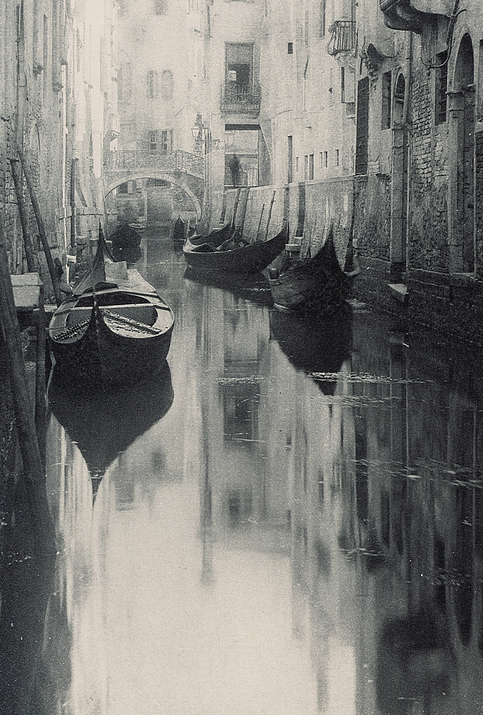
A new exhibition at The John and Mable Ringling Museum of Art asks a question that has dogged photographers since the 1800s: does a camera produce art, or just a record?
"The Evocative Lens: Pictorialism and the Rise of Fine Art Photography," on view through Wednesday, Sept. 16, draws entirely from The Ringling's permanent collection to trace the moment when photographers first insisted their medium belonged alongside painting and sculpture. Christopher Jones, the Stanton B. and Nancy W. Kaplan Curator of Photography and Media Arts, organized the show after more than a decade of watching the museum's holdings grow.
"Through the gifts that we've gotten over the past decade or so, we have some really great examples of Pictorialism and … we could tell an interesting story about this pivotal time and the history of art and photography," Jones told Your Observer.
The exhibition centers on the Pictorialist movement, whose practitioners deliberately emulated painters and graphic artists to separate their work from the snapshot culture that exploded after George Eastman introduced the Kodak No. 1 box camera in 1888. Alfred Stieglitz led the charge, founding the Photo-Secession group in 1902 with Edward Steichen, Clarence H. White, and Gertrude Käsebier. The group published a quarterly magazine called Camera Work, printed photographs using photogravure on metal plates, and showed work at a gallery at 291 Fifth Ave. in New York known simply as "291."
That same gallery later introduced Americans to Pablo Picasso and Constantin Brancusi, and championed Georgia O'Keeffe, who married Stieglitz in 1924.
Among the specific works on display: White's "Edge of Woods—Evening," a photogravure showing his sister-in-law gazing wistfully into the camera at dusk; "Experiment 28," a collaboration between White and Stieglitz depicting a woman holding a glass sphere; and Stieglitz's famous 1907 photograph "The Steerage," taken aboard the ship Kaiser Wilhelm II. That image is widely read as a portrait of immigration to America, but the ship was actually sailing to Europe when Stieglitz pressed the shutter.
The show also highlights women who shaped the movement. Because photography had no formal training requirements, artists like Käsebier, Anne Brigman, and Eva Watson-Schütze worked at the forefront. Watson-Schütze's 1904 platinum print "Nude Woman on a Rock" is displayed in the Ulla R. and Arthur F. Searing Wing.
In the same Your Observer interview, Jones described the era as "an origin moment when everything was kind of wide open." He has been at The Ringling since 2012.
By the 1910s and 1920s, many Pictorialists moved away from imitating painters and began developing visual languages unique to the camera, shaped by emerging modernist ideas.
If you go
- What: "The Evocative Lens: Pictorialism and the Rise of Fine Art Photography"
- Where: The Ringling, 5401 Bay Shore Rd., Sarasota
- When: On view through Wednesday, Sept. 16. Open daily 10 a.m.–5 p.m.; Thursdays until 8 p.m. ("Art After Five")
- Admission: $30 adults, $5 ages 6–17, free under 6. Thursday evenings $15 (5–8 p.m., Museum of Art and Bayfront Gardens). Free on Mondays (Museum of Art, Bayfront Gardens, and Glass Pavilion).
- Info: ringling.org/event/the-evocative-lens
Upcoming at The Ringling
- Art After Five: Every Thursday, 5–8 p.m. Discounted evening admission to the Museum of Art and Bayfront Gardens.
- Free Mondays: Museum of Art, Bayfront Gardens, and Glass Pavilion open to the public at no charge.

.jpg)